Among the most underestimated waste streams in terms of environmental impact are cigarette butts. A report released by the World Health Organization (WHO) in May 2022, Tobacco: Poisoning our Planet, estimates that approximately 4.5 trillion cigarette butts are discarded worldwide every year. They represent a serious environmental hazard: as the report highlights, each butt releases over 7,000 chemical substances into the ecosystem – including heavy metals and nicotine residues – with documented and persistent effects on soil, surface water, and wildlife.
Closing the Loop Through Partnership
To make a real contribution to reducing littering, Unigrà launched a partnership project in early 2025 with Human Maple, an Italian start-up from Emilia-Romagna specialising in the collection and repurposing of cigarette butts, both conventional and electronic. This collaboration, which sits within the framework of the #Riciccami campaign, goes beyond simply capturing waste: it aims to transform it into value. Interactive ‘survey’ ashtrays have been installed at the Conselice facility. These units encourage the separate collection of cigarette butts through gamification mechanisms, which, according to the start-up’s data, reduce littering by 32–46%. The heart of the innovation lies in the butt-treatment process, which uses an organic solvent for final purification. Harmful substances are extracted and cellulose acetate isolated. From this material, a versatile recycled fibre is obtained, suitable for use in textile padding, cushions and accessories, as well as in the production of thermal insulation and soundproofing materials.2025 Results: the Numbers Behind Circularity
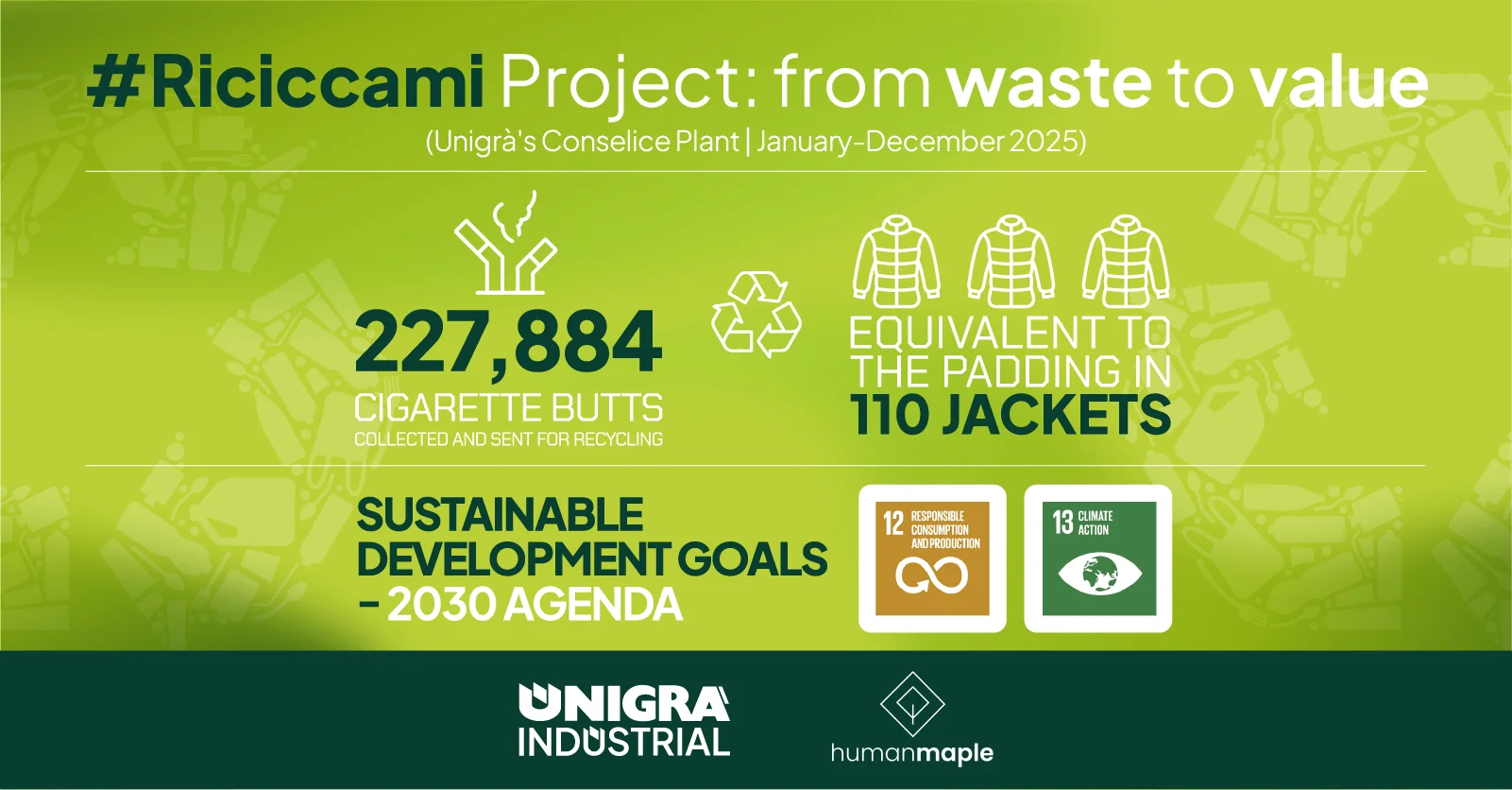
Unigrà has collected around 227,884 cigarette butts, equivalent to the padding used in 110 winter jackets. Unigrà’s collection and recycling of cigarette butts in 2025 has helped prevent the potential littering of materials in the environment thanks to an organised collection system.A Strategy Built on Everyday, Impactful Actions
This initiative aligns with the UN 2030 Agenda, particularly SDG 12 (Ensure sustainable consumption and production patterns) and SDG 13 (Take urgent action to combat climate change and its impacts). Through technological innovation and start-up partnerships, Unigrà turns its commitment to the circular economy into impactful actions – reducing waste and transforming it in value through recycling and reuse.